• Skip to primary navigation
  • Skip to main content
  • Skip to primary sidebar
  • Skip to footer
Planet Home

Planet Home

Culture Solutions

  • ECOSYSTEM
    • EAT
      • Food Security & Production
      • Land Stewardship
      • Ocean Stewardship
      • Health + Wellness
    • MAKE
      • Circular Economies
      • Green Manufacturing
      • Material Science
      • Regenerative Ecosystems
    • MOVE
      • Clean Transport
      • New Fuel Sources
      • Virtual Connections
      • Ecological Explorations
    • LIVE
      • Sustainable Communities
      • Biodiversity
      • Atmospheric Conditions
      • Renewable + Equitable Energy
  • VENTURE STUDIO
  • LABS
  • EVENTS
  • ARTICLES
    • Featured
    • Network
    • Press
  • Menu bars
  • COMPANY
  • VENTURE STUDIO
  • LABS
  • ABOUT
  • CONTACT
  • NETWORK
  • ECOSYSTEM
  • COMMUNITY
  • MEDIA
  • VIDEO
  • PHOTO
  • PRESS
  • Podcast
  • EVENTS
  • ALL
  • 2019 SUMMIT
  • 2017 SUMMIT
  • Terms of Use
  • Privacy Policy
  • Facebook
  • Instagram
  • LinkedIn
  • Pinterest
  • Twitter
  • YouTube

What is a Circular Economy?

What is a Circular Economy?

August 28, 2020 by Antony Randall Leave a Comment

Most people know what an economy is and have a basic understanding of how it works. However, the relationship between our economy and the environment can be complicated and infinitely interconnected in ways that we don’t often think about. In a world that is facing many environmental challenges, we need to stretch our minds and invest in economic practices that allow us to live in better balance with the planet.

This is what a circular economy aims to do.

What is a Circular Economy?

A circular economy is a system that aims to reduce, or ideally eliminate, waste. In addition, it is an economy that makes the most out of its resources to reduce waste and inefficiency  – a win-win for the planet and our bank accounts.

Not only does a circular economy aim to conserve natural resources, but it also encourages reuse, recycling, and innovation for longer product life, among other actions. The common phrase Reduce, Reuse, Recycle is essentially the idea of a circular economy.

Those economies adopting these approaches are often referred to as regenerative economies. They minimize use of materials that would not be able to be reused, so every output of the system can re-enter as an input.

Why Do We Need It?

Now that we’ve discussed what a circular economy is, why is it important? The world currently produces 2.01 billion metric tons of municipal solid waste annually. Unfortunately, this is predicted to rise by 70% by 2050 unless we start embracing a significant cultural shift. Circular economies would reduce this wastefulness. In 2018, the first Circularity Gap Report found that the world is only 9.1% circular, so we’ve got a long way to go. The ideal situation would be to get to zero waste, but we know humans aren’t perfect and are not ready to completely upend comfortable habits.

Everyone gains from a circular economy through sustainability, business and economic opportunities, and environmental and social benefits. Not only do circular economies reduce greenhouse emissions, but it has also been shown that they can save our companies billions. Newly implemented practices could create jobs, therefore boosting economic growth. A push for zero-waste will lead to innovation within production, often increasing competitiveness. Sectors such as the car industry, the home appliance industry, and the electronics industry would greatly benefit from circular economies, especially if products can be recycled or reused to build future products.

Consumers will benefit from products that last longer rather than breaking down within a short period of time. This improves their quality of life and will eventually save them money as they will buy new products less frequently.

Bringing the Circular Economy Into Our Sphere

The problem may seem huge, but if we work together we can make solutions a reality. To create a circular economy, we need to focus on renewable resources, renewable energy, and waste management practices.

One area where circular economies would reduce waste is in the use of plastics. Plastics are currently either incinerated, sent to the landfill, or eventually end up in the ocean. This means that they’re either producing harmful emissions, adding to waste, or killing oceanic wildlife. This is why we should be supporting organizations like BioCellection, a company that works to upcycle hard-to-recycle plastics, and Upstream Solutions, an organization which aims to create alternative uses for plastics that are typically thrown away.

Beyond these large-scale solutions, there are simple changes that anyone can make. A transition to renewable energy sources, reduction in purchasing of single-use plastics, and reducing waste wherever possible makes a huge difference. Many have transitioned to composting and using compostable packaging to generate less waste. Electronics can be recycled in safe ways rather than thrown away. If you would like to see a waste-free lifestyle in action, Katherine Kellogg’s blog Going Zero Waste shares how to transition to a zero-waste lifestyle as well as her own experience living it. For a perspective on how going waste free can benefit the world and delight your stomach, check out Anne-Marie Bonneau’s blog Zero-Waste Chef. Going zero-waste can be tasty and energizing!

We live in a waste-filled world facing many challenges. We only have one planet home (so far!) and it’s up to us to take care of it. If we all do our part to adopt circular economy practices we will all benefit. If we all make simple changes to our everyday lives (micro-actions) and work to support organizations prioritizing these efforts on the grand-scale (macro-actions), we can make our world cleaner, safer, and more sustainable for ourselves and for generations to come. 
Filed Under: Make, Recent Tagged With: circular economy

When It Comes to Equality, We Have to Fight for Climate Equity Too

August 26, 2020 by Neil Sahota Leave a Comment

When it comes to combating the widening inequality gap, we rarely think about environmental issues as part of the disparate impact to people of color and frontline communities. This goes far beyond affordability of air conditioning (or heating) concerns. Think about pollution. San Bernardino County in California has consistently poor air quality that creates chronic health issues, especially for the children growing up in these communities. While the world talks about climate change in terms of very broad impacts, we often overlook that it can impact communities very differently. 

The Climate Equity Bill introduced by Vice Presidential candidate Kamala Harris and Representative Alexandria Ocasio-Cortez aims to address these issues by bringing in representation from frontline communities when crafting climate policy and legislation.

It Starts with Environmental Justice

Imagine if you didn’t have clean drinking water at home. Your family constantly breathes polluted air and has to worry about a toxic waste facility nearby. Sounds pretty grueling, but most people probably don’t feel this happens in the United States. Well, it does for hundreds of communities. Communities of color have higher exposure rates to air pollution than their white, non-Hispanic counterparts. A Yale University study found that non-Hispanic whites had the lowest exposure rates for 11 of the 14 pollutants monitored in the study. Moreover, a report titled “Toxic Waste and Race at Twenty” reviewed data collected over a 20-year time period and found that more than half of the people who live within 1.86 miles of toxic waste facilities in the United States are people of color.

This is hard to imagine, especially in a country like the United States. This is exactly why representation is such an important factor when it comes to policy making. The Climate Equity Bill brings the people from these communities to the table so we know their experiences, incorporate their needs, and create more meaningful policy decisions that will help all communities and, more importantly, start addressing the real environmental problems of the frontline communities. 

As part of the Climate Equity Bill, Senator Harris and Representative Ocasio-Cortez have proposed an independent Office of Climate and Environmental Justice Accountability to represent the views of frontline communities in policymaking. This Office will conduct research on issues and trends in frontline communities, measure the costs of regulations on frontline communities, and monitor government compliance. For the Office, people and allies from the frontline communities will represent these concerns through the formation of a Board of Advisors. With this first hand experience present, this Board will be a powerful force in creating climate equality and justice.

Holding Our Leaders Accountable

To make this real and meaningful, the Climate Equity Bill also proposes accountability measures for Congress and the Executive Branch, including an “equity score” on any climate legislation. This score will estimate the impact of any policy frontline communities as a validation to ensure people of color, low wage communities, and the elderly are not disproportionately impacted by the legislation. For the Executive Branch, any rules and regulations that would have a significant impact on frontline communities would go through an additional layer of review of compliance with environmental policies regulations. Similarly, the Climate Equity Bill also requires that federal grants for investments on the planet also go through a review to ensure that frontline communities would benefit from the investments made through a grant.

While some will argue about additional bureaucratic “red tape” and costs, this bill actually creates tangible benefits, not just environmentally, but also economically. Changes in our atmospheric conditions could slash up to 10% of the GDP by 2100, more than double the losses of the Great Recession. However, the policies proposed by Senator Harris and Representative Ocasio-Cortez are designed to achieve a carbon-neutral economy by 2050, which would stem the GDP losses. In fact, they may even help grow GDP through the creation of new, green jobs and facilitating a healthier population that would reduce healthcare costs. Likewise, Senator Harris has called for a $10 trillion increase in spending over a decade as well as a price on carbon, with a dividend that is returned directly to households. That’s a strong incentive for people to be green!

The past few months have been incredible as we have seen people join together to make social and racial justice a reality. The tragic deaths of George Flyod, Breonna Taylor, and Ahmaud Arbery are, sadly, just a handful of incidents but have helped sparked understanding on why Black Lives Matter, the poor level of diversity and inclusion in law and business, and the broad and deep need for equality in every facet of our lives. Let us make sure we include environmental issues as part of transformation to social justice.

What You Can Do To Help

Help empower communities with better representation by supporting organizations like Earth Guardians, which trains diverse youth to become effective leaders in environmental and social justice. Donate to Earth Guardians and help shape the next generation of leaders.

Spread the word about innovative technologies that are designed to help address the challenges faced by vulnerable populations, such as the flood-mapping system created by Cloud to Street. Cloud to Street’s flood monitoring technology helps city planners and natural disaster relief agencies to better understand flood risks so that at-risk communities can be better protected. Help raise awareness about Cloud to Street so that more communities, including yours, can benefit from its cutting-edge technology.

Finally, with elections coming up in November, do some research to learn more about the policies proposed by your local, state, and federal representatives that can affect our planet and our communities.

Creating a healthier, more equal, and inclusive future for our planet is a collective effort, and each of us has the power to make an impact – including you!

Filed Under: Live, Recent Tagged With: environmental justice, equity, policy

Earth Overshoot Day Pushed Back Due to Coronavirus Pandemic

August 21, 2020 by Rayanne Piana Leave a Comment

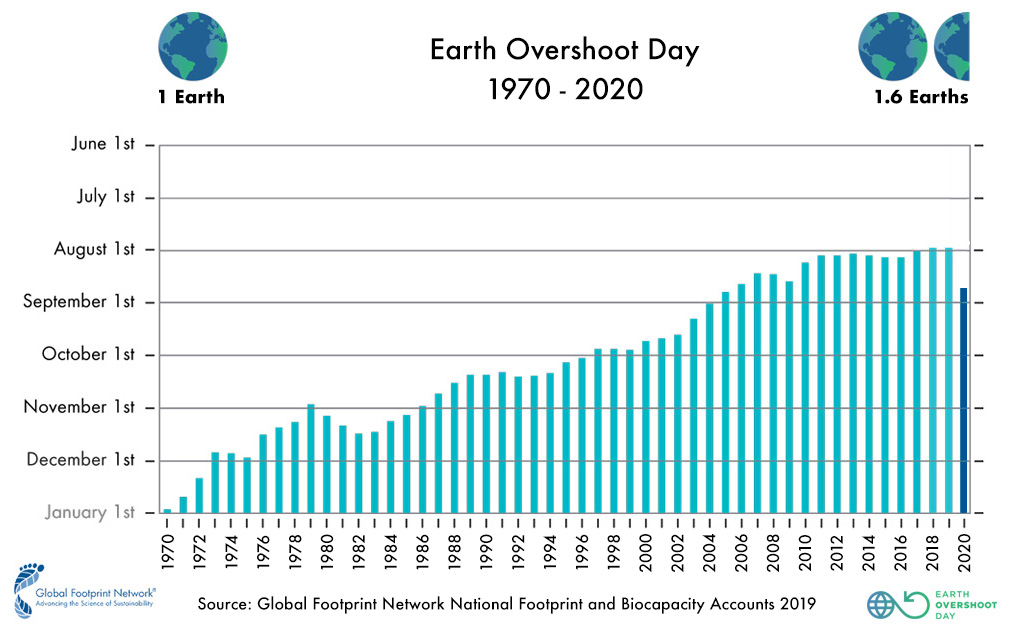
This year, Earth Overshoot Day falls on Saturday, August 22 – three weeks later than it did in 2019, an indication of the coronavirus pandemic’s impact on human activity and our impact on the planet. However, there’s more work to be done to build a lasting positive relationship between humanity and the planet.

What is Earth Overshoot Day?

Earth Overshoot Day marks when humanity’s use of natural resources exceeds the amount of resources the planet is able to regenerate within the year. In other words, the date marks when we have maxed out our resource budget and start accumulating debt to the planet.

This is calculated by the Global Footprint Network, an international research organization that equips decision-makers with the tools they need to help the human economy operate within the ecological limits of the planet. The same way an accountant measures income against expenditures, the Global Footprint Network measures the supply and demand of ecological resources.

So, how is this measured exactly? First, researchers calculate the earth’s biocapacity, which is the amount of ecological resources the planet is able to regenerate each year. Next, biocapacity is divided by humanity’s ecological footprint (determined by the demand for resources that year) then multiplied by 365 for each day of the year.

(Earth’s Biocapacity / Humanity’s Ecological Footprint) x 365 = Earth Overshoot Day

The Global Footprint Network derives its information from over 15,000 data points, mostly from sources provided by the United Nations.

Image Source: Global Footprint Network

Earth Overshoot Day Delayed by Coronavirus

This year, the forced slowdown in human activity caused by the pandemic had a number of positive impacts on the environment, causing us to conserve resources and thus push back the date of Overshoot Day.

On average, humans use 60% more than the earth is able to regenerate. But, with much of the world on lockdown this year, a reduction in fossil fuel usage from transportation, aviation, industrial, and power sectors reduced carbon emissions by 15%. Also, reduced demand for forest products reduced the forestry footprint by 8.4%.

While reducing our footprint is the goal, the results of the pandemic are not a sustainable solution.

“The tragedy of this year is that the reduction of carbon emissions is not based on a better infrastructure such as better electricity grids or more compact cities,” Mathis Wackernagel, founder and president of the Global Food Network, told DW. “We need to move the date by design, not by disaster.”

Establishing a Regenerative Ecosystem

So, how do we create a more sustainable approach to healing the planet? As Wackernagel said, we need to improve our infrastructure and design new ways of eating, making, moving, and living that can support a regenerative ecosystem. 

By creating a system that can restore, renew, and revitalize our natural resources, we’ll be able to reduce humanity’s footprint and create a positive impact on environmental conditions. Thankfully, organizations like Ecosystem Restoration Camps and Kiss the Ground and are leading the charge.

Ecosystem Restoration Camps bring together farmers, landowners, community members, and experts to restore degraded ecosystems. Members of the camps take a hands-on approach at rehabilitating land that has been damaged by unsustainable agricultural practices. By increasing biodiversity, biomass, and soil organic mass, they have helped reverse ecological degradation in 23 camps around the world.

Become a member to support Ecosystem Restoration Camps.

Kiss the Ground is a non-profit dedicated to increasing societal awareness about regenerative solutions. They also have several programs, such as their Farmland Program which provides farmers the resources they need to transition their practices to more ecologically positive processes. Kiss the Ground also has a documentary, narrated by Woody Harrelson, premiering on Netflix on September 22.

Support Kiss the Ground and join the Planet Home network to learn more about regenerative solutions.

Filed Under: Make, Recent Tagged With: carbon emissions, earth overshoot day, regenerative ecosystems

Patriot Act with Hasan Minhaj Comes to an End

August 21, 2020 by Rayanne Piana 2 Comments

On Tuesday, August 18, Hasan Minhaj, a Planet Home solutionist, announced via Twitter that his Netflix series, Patriot Act, has come to an end. 

What a run. @patriotact has come to an end. I got to work with the best writers, producers, researchers, and animators in the game. My 2 babies were born and grew up with the show. TY to @Netflix and everyone who watched. Now it’s time to return these screens to Best Buy 😎 pic.twitter.com/4s4TrsKWe6

— Hasan Minhaj (@hasanminhaj) August 18, 2020

For six seasons, Patriot Act with Hasan Minhaj explored global news, politics, and culture, covering issues such as civil rights, student loans, mental health, and many more. Lauded for its impressive research, brilliant analysis, quality production, and expert comedic delivery, the show earned an Emmy, a Peabody Award, two Webby Awards, and landed Minhaj a spot on the Time 100 Most Influential People list.

In every episode, “The Daily Show” alumnus delivered solid, deeply researched reporting through unapologetically critical takes, served with a side of laughter. As the show’s creator and host, Minhaj brought the same nuanced perspective, humor, and storytelling skills to the screen that he did to the stage of our Planet Home 2019 event, where he was also our host.

Looking Back on Patriot Act’s Coverage of Environmental Issues

Minhaj used the show’s platform to raise awareness about the challenges our planet faces, taking a deep dive into the social and industrial phenomena that have a negative impact on our environment. One episode, “Oil,” dove into the fossil fuel industry. Minhaj discussed the causes and effects of the Taylor oil spill and took a closer look at the impacts and scale of the United States’ continued reliance on and expanding production of oil as a fuel source.

One of our favorite episodes of Patriot Act shined a light on the environmental impacts of the fast fashion industry. The third episode of the fifth season, “The Ugly Truth About Fast Fashion” covered the way the constant demand for new styles has created an industry that turns out large volumes of new styles every day.

Minhaj explains that the production of synthetic materials uses 342 million barrels of oil annually and that over 10,000 liters of drinking water can be used to produce a single piece of clothing. That’s a tough statistic to swallow, considering the average American only wears a piece of clothing 3 times before it gets sent to a landfill.

How Do We Make Fashion More Sustainable?

Luckily, we’re seeing positive change happen in the fashion industry thanks to solutionists like Jennifer Sey of Levi’s, where they’ve found a way to reduce the amount of water needed to produce a pair of jeans by a whopping 95%. Environmental educators like Dominique Drakeford are helping companies raise the standards for sustainability in fashion through green manufacturing.

The best way to improve the environmental impact of fashion is to move the industry to incorporate the concepts of a circular economy. The Ellen MacArthur Foundation is helping to accelerate the transition towards a circular economy by working with businesses and governments to design a regenerative ecosystem. The foundation has partnered with fashion leader Stella McCartney to publish a report that outlined the environmental impact of the textile economy.

What you can do to help? Learn more about the Ellen MacArthur Foundation or sign a pledge to help fight pollution.

Although Patriot Act has come to an end, we’re thankful to everyone at the show for shining a light on these important issues and we look forward to seeing Hasan Minhaj and team continue to do incredible work.

Filed Under: Make, Recent Tagged With: circular economy, fast fashion, solutionist

Transmute Your Artistry: A Virtual Masterclass on Live Performance | Aug. 24 – 28

August 19, 2020 by Rayanne Piana 2 Comments

With live performances still on hold in many places due to the pandemic, now is the perfect time for artists to focus on perfecting their craft. For those looking to elevate their live performance skills, join the free Transmute™ Your Artistry masterclass series from August 24 – 28, 2020.

Transmute Your Artistry: A Masterclass on Live Performance

Transmute™ Your Artistry is a free week-long masterclass series designed to help artists step up their live performance capabilities to grow their art and their business. The event will feature an incredible lineup of featured special guests who will share groundbreaking concepts and knowledge, including interactive performance techniques, augmenting classical instruments, and the powers of Ableton.

Special guest presenters include Suzanne Ciani, The Album Leaf, Randy George, Trevor New, Ruby Mountain and Laura herself will be unveiling some next-level performance art.

Event registrants can also enter the Transmute™ From Home Performance Contest for a chance to win prizes from the sponsors Universal Audio, Eventide, Native Instruments, Output, and Artiphon.

This masterclass series kicks off the 8-week Transmute™ Accelerator program, which is designed to empower, evolve, and educate independent artists and producers to create a vision and design a live show from the ground up.

Curated by a Creative Master

Creator of the Transmute™ Accelerator program, Laura Escudé is a Los Angeles based artist, entrepreneur, and live show designer who uses finds innovative ways to use technology to create immersive experiences of art and music.

Given her major accomplishments as an industry-acclaimed artist and award-winning musician, it’s no wonder Escudé is able to put together an impactful masterclass to share her wealth of knowledge. A few of her career highlights include designing shows for Kanye West and Jay Z, and opening for Miguel on his 2015 Wildheart tour, on top of developing a top-tier educational program accessed by professionals and artists around the globe.

Events like Transmute™ Your Artistry were born of Escudé’s passion for mentorship, community, and enriching other artists.

“Community and education are the most important things to me as an artist and a mentor to artists seeking more control and creative freedom in their careers,” Escudé said. “I created Transmute™ as an online program to impact as many aspiring & established artists to be empowered to blaze their own ways & means to live inspired lives and make a living from their passions.”

Register now for Transmute™ Your Artistry to learn from Laura Escudé and other industry masters.

Filed Under: Move, Recent Tagged With: event

New Regenerative Organic Certification Raises Standards for Agriculture

August 18, 2020 by Rayanne Piana Leave a Comment

Over the past 50 years, agricultural productivity around the world has more than doubled to meet the food security needs of a growing population. While robust agricultural practices have increased food output, they have also increased the level of detrimental effects that farming can have on the environment.

Regulators, advocates, and industry leaders have worked together to improve agricultural technology and standards to create greener, more sustainable farming practices. In fact, studies show that between 1980 and 2015, greenhouse gas emissions have decreased by 31%, irrigation water usage has declined 46%, and soil erosion significantly decreased by 58%. 

However, there is still a long way to go. The global agricultural sector still accounts for roughly 20% of the world’s total greenhouse gasses. To create an even brighter future for sustainable agriculture, companies should strive to meet the requirements of the newly introduced Regenerative Organic Certification (ROC) – what is sure to become the gold standard in organic food production.

What is Regenerative Organic Farming?

Regeneration organic farming is the pursuit of creating a restorative, sustainable agricultural system that operates in better harmony with the ecosystem, wildlife and communities of farmworkers. The goal of regenerative organic farming is to reverse the harmful effects of poisonous chemicals, habitat destruction, and exploitation. Instead, a regenerative approach at agriculture seeks to empower communities to create a positive impact on the planet.

What is the Regenerative Organic Certification?

Regenerative Organic Certified is a new certification for food, fiber, and personal care ingredients that revolutionizes the standards for these products and their production processes. Introduced by the Regenerative Organic Alliance (ROA), the certification is meant to help farmers and corporations cut away practices that damage the environment, replacing them with better farming for a better future.

The Regenerative Organic Certification has three main pillars:

Soil Health

The ROC encourages companies to adopt agricultural practices that protect soil quality, preventing degradation. The goal of the certification’s soil health standards is to increase soil organic matter, decrease the use of synthetic chemicals, and promote biodiversity.

a handful of soil

Animal Welfare

The ROA is on a mission to ensure humane practices in the handling of animals. To maintain the certification, farming companies must comply with the ROA’s requirements that animals are free of any distress, unhealthy conditions, or cruel treatment.

a cow on a farm standing under a tree

Social Fairness

Now more than ever, fairness, equality, and ethical treatment of all people is top of mind for many. The social fairness pillar of the ROC establishes the highest standard of fair treatment for farmworkers, including living wages and good working conditions, among other things. The ROA’s goal is to raise the standards of labor practices around the world.

farm worker planting produce

Who is Practicing Regenerative Organic Farming?

The Regenerative Organic Alliance rolled out the certification with a pilot program, where companies tested their ability to meet the standards of soil health, animal welfare and social fairness in order to be regenerative organic certified. The pilot program participants included Alexandre Family Farm, Guayakí Herba Mate, Maple Hill Creamery and Patagonia, just to name a few.

According to Alexandre Family Farm, their commitment to regenerative practices and environmental stewardship has enabled them to increase year-round biodiversity of their pastures, which helps ensure their cows are 100% grassfed. Regenerative farming has also helped their farm sequester carbon through planned grazing. Based on research by the Rodale Institute, if current farmland made the switch to regenerative organic practices, 100% of annual global CO2 emissions could be sequestered in the soil.

The new requirements under the Regenerative Organic Certification will shape agriculture for the better, raising the standards for sustainability and social good. The certification is rooted in long-term solutions for the environment that will lead us towards a hopeful future for Planet Home.

Filed Under: Eat, Recent Tagged With: agriculture, farming, food production, organic

  • « Go to Previous Page
  • Page 1
  • Interim pages omitted …
  • Page 51
  • Page 52
  • Page 53
  • Page 54
  • Go to Next Page »

Primary Sidebar

Recent Posts

  • PLANET HOME Announces $1 Million Tough Tech Prize at Inaugural Gala During Tough Tech Week
  • Planet Home and DataEnergy are solving the Green Computing Dilemma with Renewable AI Infrastructure
  • The Great AI Scale-Up: Balancing Compute Power with Planetary Boundaries
  • The Algorithm’s Bargain: Is AI Really for Good?
  • Code, Culture, and Creation: How AI is Remixing Entertainment’s DNA

Recent Comments

  • Liam Jacobs on Fricken’ Flying Taxis: The Future of Travel is Closer Than You Think
  • Izabella Bauer on The Pressing Plastic Problem
  • Broderick Ruiz on The Pressing Plastic Problem
  • Cherish Velez on The Pressing Plastic Problem
  • Anika Scott on The Pressing Plastic Problem

Archives

  • November 2025
  • April 2025
  • February 2025
  • January 2025
  • June 2022
  • April 2022
  • March 2022
  • February 2022
  • January 2022
  • December 2021
  • November 2021
  • October 2021
  • September 2021
  • August 2021
  • July 2021
  • June 2021
  • May 2021
  • April 2021
  • March 2021
  • February 2021
  • January 2021
  • December 2020
  • November 2020
  • October 2020
  • September 2020
  • August 2020
  • July 2020

Categories

  • AI
  • Community
  • Eat
  • energy
  • Featured
  • Live
  • Make
  • Move
  • Network
  • Press
  • Recent
  • Solutionist 100
  • Solutionists Making Moves
  • Solutions

Meta

  • Log in
  • Entries feed
  • Comments feed
  • WordPress.org

Design

With an emphasis on typography, white space, and mobile-optimized design, your website will look absolutely breathtaking.

Learn more about design.

TRENDING NOW

  • PLANET HOME Announces $1 Million Tough Tech Prize at Inaugural Gala During Tough Tech Week
  • Planet Home and DataEnergy are solving the Green Computing Dilemma with Renewable AI Infrastructure
  • The Great AI Scale-Up: Balancing Compute Power with Planetary Boundaries
  • The Algorithm’s Bargain: Is AI Really for Good?
  • Code, Culture, and Creation: How AI is Remixing Entertainment’s DNA

NEVER MISS A SOLUTION!

Sign up for our mailing list to stay up to date on planet saving solutions, news, and events from PLANET HOME!


BROWSE BY TAGS:

action carbon carbon emissions circular economy coronavirus eat education energy environment esg events fashion finance food green holidays industry lifestyle live make material science move music nature ocean oceans ocean stewardship planet plant-based plastic profile recycling s100 solutionist solutionists solutions sustainability tech technology tiktok transportation vegan waste water wildlife
Locations
Resources
Legal

Footer

Locations
Resources
Legal
  • Facebook
  • Instagram
  • LinkedIn
  • Pinterest
  • Twitter
  • YouTube
  • San Francisco
  • Los Angeles
  • New York
  • About PLANET HOME
  • Contact
  • Media
  • Employment
  • Terms of Use
  • Privacy Policy
  • Press

©2021 Planet Home. All rights reserved.
Use of and/or registration on any portion of this site constitutes acceptance of our User Agreement (updated 5/25/18) and Privacy Policy and Cookie Statement (updated 6/8/21) Your California Privacy Rights. The material on this site may not be reproduced, distributed, transmitted, cached or otherwise used except with the prior written permission of PH.

This website uses cookies to improve your experience. We'll assume you're ok with this, but you can opt-out if you wish. Cookie settingsACCEPT
Privacy & Cookies Policy

Privacy Overview

This website uses cookies to improve your experience while you navigate through the website. Out of these cookies, the cookies that are categorized as necessary are stored on your browser as they are essential for the working of basic functionalities of the website. We also use third-party cookies that help us analyze and understand how you use this website. These cookies will be stored in your browser only with your consent. You also have the option to opt-out of these cookies. But opting out of some of these cookies may have an effect on your browsing experience.
Necessary
Always Enabled
Necessary cookies are absolutely essential for the website to function properly. This category only includes cookies that ensures basic functionalities and security features of the website. These cookies do not store any personal information.
Non-necessary
Any cookies that may not be particularly necessary for the website to function and is used specifically to collect user personal data via analytics, ads, other embedded contents are termed as non-necessary cookies. It is mandatory to procure user consent prior to running these cookies on your website.
SAVE & ACCEPT