• Skip to primary navigation
  • Skip to main content
  • Skip to primary sidebar
  • Skip to footer
Planet Home

Planet Home

Culture Solutions

  • ECOSYSTEM
    • EAT
      • Food Security & Production
      • Land Stewardship
      • Ocean Stewardship
      • Health + Wellness
    • MAKE
      • Circular Economies
      • Green Manufacturing
      • Material Science
      • Regenerative Ecosystems
    • MOVE
      • Clean Transport
      • New Fuel Sources
      • Virtual Connections
      • Ecological Explorations
    • LIVE
      • Sustainable Communities
      • Biodiversity
      • Atmospheric Conditions
      • Renewable + Equitable Energy
  • VENTURE STUDIO
  • LABS
  • EVENTS
  • ARTICLES
    • Featured
    • Network
    • Press
  • Menu bars
  • COMPANY
  • VENTURE STUDIO
  • LABS
  • ABOUT
  • CONTACT
  • NETWORK
  • ECOSYSTEM
  • COMMUNITY
  • MEDIA
  • VIDEO
  • PHOTO
  • PRESS
  • Podcast
  • EVENTS
  • ALL
  • 2019 SUMMIT
  • 2017 SUMMIT
  • Terms of Use
  • Privacy Policy
  • Facebook
  • Instagram
  • LinkedIn
  • Pinterest
  • Twitter
  • YouTube

Burning Man Went Virtual This Year, But Is Its Future Sustainable?

Burning Man Went Virtual This Year, But Is Its Future Sustainable?

September 9, 2020 by Rayanne Piana 3 Comments

Like many largescale events and festivals in 2020, Burning Man’s in-person gathering at Black Rock City was canceled in response to the coronavirus pandemic. Rather than flocking to the Nevada desert last weekend, Burners entered an online Multiverse. Here, attendees accessed a digital rendering of Black Rock City, complete with virtual art installations, theme camps, and VR performances.

The pandemic has pushed the world of live entertainment to innovate in unprecedented ways. Event organizers are reckoning with the very nature of the experiences they aim to create. Can technology translate the festival experience into newer, possibly better formats? What is the future of live entertainment? Most importantly, what should the future of live entertainment look like?

The Environmental Impact of Large-Scale Events

The infrastructure behind large-scale events creates an ecosystem that makes an impact on the local land, governance, and community where an event is hosted. The way events are structured and designed also influences the environmental impact of event attendees. Between the amount of waste created and the carbon emissions created by traveling fans, events like music festivals have a huge ecological footprint to solve for.

So, almost exactly a year ago in the fall of 2019, the Planet Home team teamed up with Burners Without Borders in an EcoSprint that would do just that – develop solutions that will create a more positive relationship between the Burning Man experience, the local community, and the planet.

What is an EcoSprint?

We designed EcoSprints as a collaborative process for developing solutions that can be fostered, implemented, and amplified to make a tangible impact on the planet. The goal is to unpack current global challenges, identify new possible futures, and reverse engineer the path forward. EcoSprint workshops bring together solutionists from diverse backgrounds to innovate through the lenses of socio-cultural, technological, economic, environmental, and political factors for positive change.
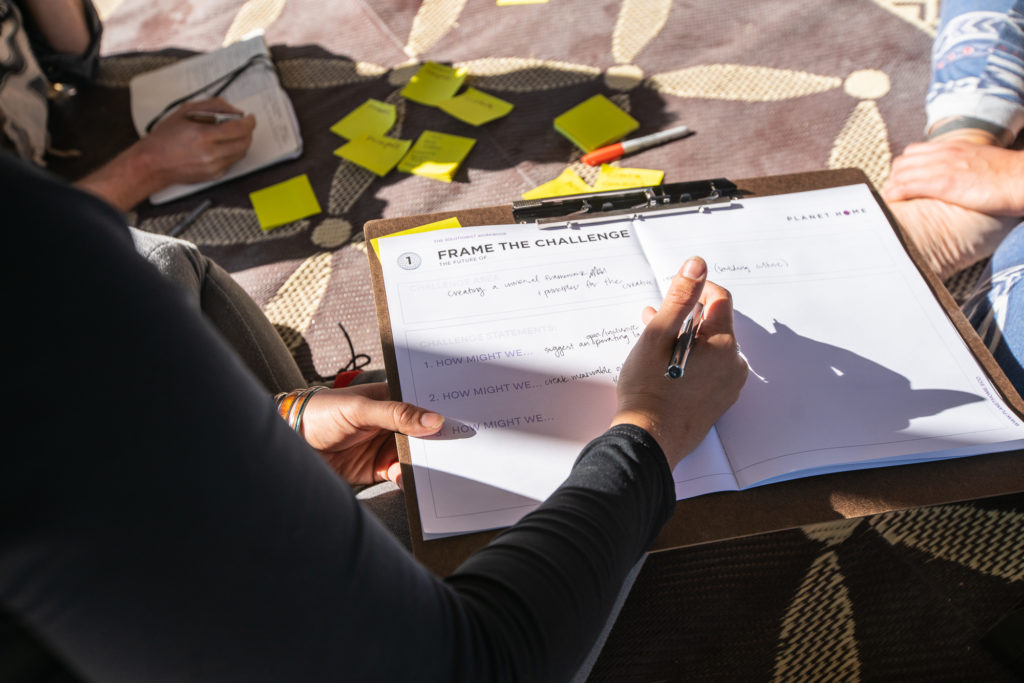
environmental solutionist filling out a worksheet

Burners Without Borders EcoSprint

Burners Without Borders (BWB) is a grassroots organization founded by Burning Man participants (Burners) dedicated to creating meaningful change through a variety of programs, from disaster relief to community projects. BWB collaborated with Planet Home to facilitate an EcoSprint in support of the development of Burning Man’s recently published 2030 Environmental Sustainability Roadmap.

In October of 2019, about 100 solutionists gathered in the Nevada desert at Fly Ranch to participate in a collective visioning of a sustainable future. Attendees included sustainability engineers, biologists, artists, local land stewards from Fly Ranch, representatives of the Buckminster Fuller Institute, and BWB members from around the globe.

Over two days, we embarked on a journey of creative thinking, reverse engineering, building human-centric design principles, future casting, and iterative group sessions. The collaborative session led to the development of solutions that would make a positive impact on the environment, Burning Man, the local community outside of Black Rock City, and potentially the world of large-scale events.
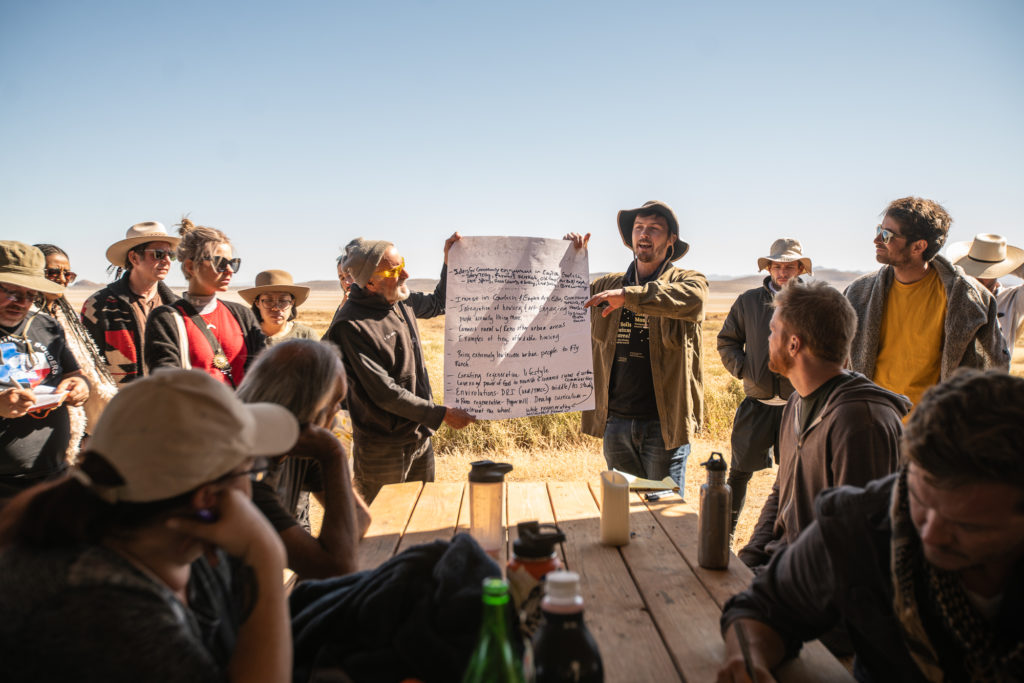
event attendees presenting environmental solutions

The Result: Regenerative Solutions

After the EcoSprint, the Planet Home team synthesized the ideas from the session to create a number of actionable solutions, including:

Carbon Positive Contribution: Implementing a carbon tax to raise funds to invest in regenerative projects that will offset Burning Man’s carbon footprint.

Composting Toilets: Introducing composting toilets to Black Rock City to repurpose human waste instead of letting it become, well, waste.

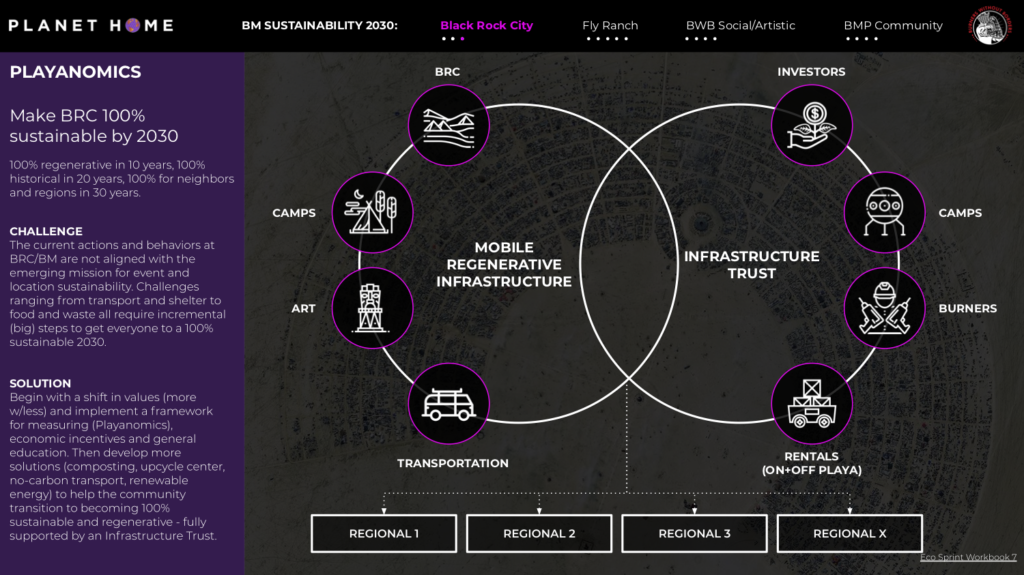
Playanomics: A framework that shifts all the actions and processes behind Burning Man towards regenerative practices that will reach 100% sustainability by 2030.
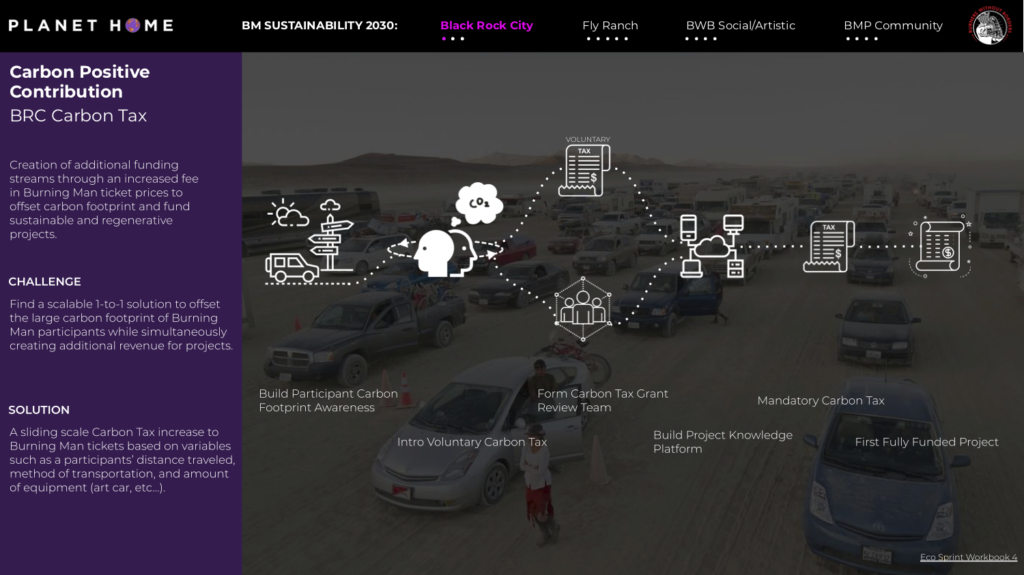
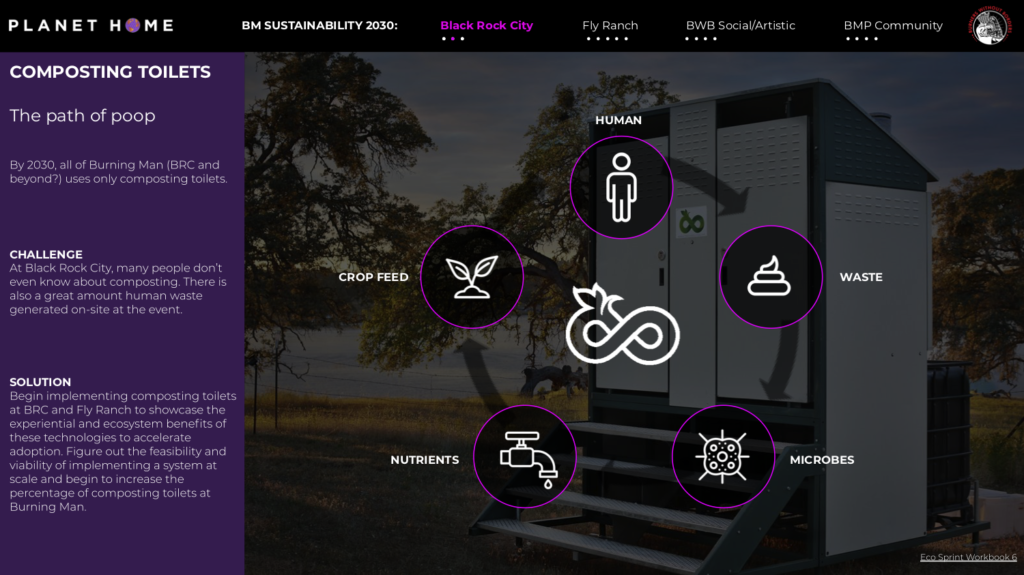
The future of Burning Man, and hopefully all festivals and live entertainment experiences, is bright. When you bring together a community of innovators, change-makers, and creative minds, the result of regenerative solutions is more than just possible – they’re waiting to be discovered. More importantly, our Planet Home is calling for these solutions to become a reality.

Together as solutionists, change is on the way!

Interested in getting involved? Here’s how:

  • Sign up for future Burners Without Borders community events
  • Join the Planet Home community to discover more environmental solutions
  • Explore Planet Home events to attend in the next EcoSprint 
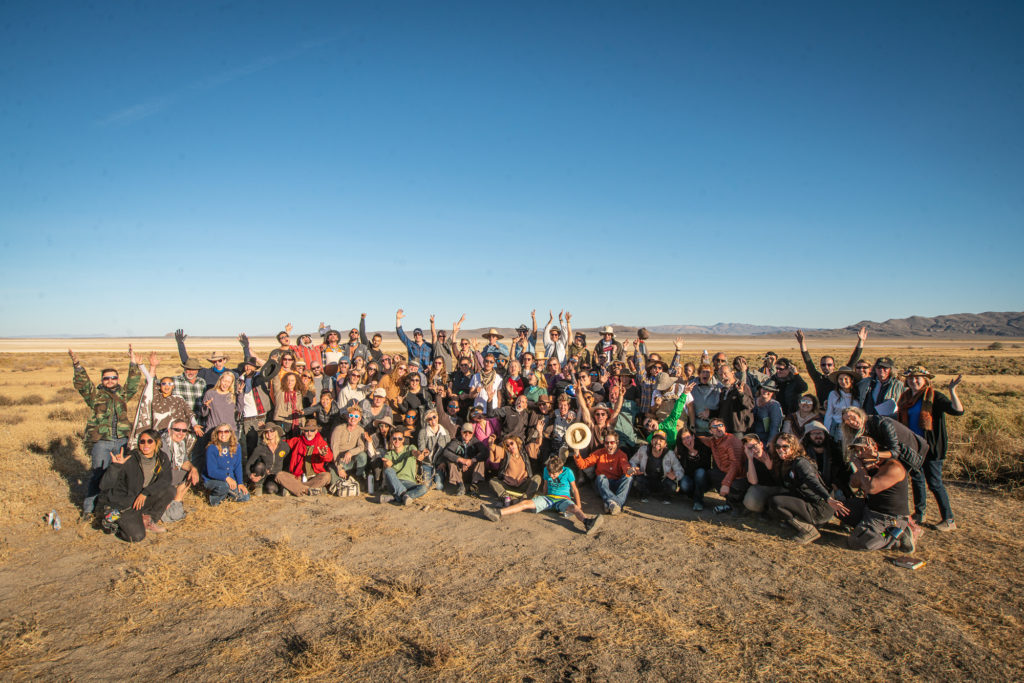
group photo of event attendees in the desert

Special thanks to solutionists Kristofer Kish (designer), Becca Dakini (head of programming), and Robert Suarez (chief solutions officer) for their contributions to this story and for making this EcoSprint possible.
Filed Under: Make, Recent Tagged With: arts and entertainment, eco sprint

The Atmosphere Protects Us, It’s Time We Protect It

September 9, 2020 by Cassandra Townsend Leave a Comment

No matter where you live, the sky is a wide-open expanse full of stars, of wonder, of beauty. What you see may be slightly different than someone across the globe; different regions have different levels of light pollution, which impacts what we see in the sky, the same as air pollution. What you see now may be different than you saw a year ago; in some urban areas of the U.S., levels of nitrogen dioxide are half of what they were a year ago as people are locked down due to COVID-19.

When you look up now, though, you might have that feeling of being small, like there is very little you can do to help the Earth; I think we’ve all had that feeling. As it turns out, though, there’s a lot we can do as individuals to help our home and to help that atmosphere that protects us from ultraviolet waves, houses the oxygen we breathe, creates the pressure that allows water to exist. In a nutshell, the atmosphere allows us to exist, to live, and to look up and feel small.

Dr. Jonathan Foley, the executive director of Project Drawdown, says it perfectly: “Yes, this is a big problem, but we do have the solutions to solve it.” The overarching solution to declining atmospheric conditions? The “drawdown” will occur when we reach a point where the concentration of greenhouse gases is declining instead of increasing.

What Are Greenhouse Gases?

Greenhouse gases in the atmosphere that prevent heat from escaping, like a hat in the winter. They include ozone, carbon dioxide, methane, nitrous oxide, and fluorinated gases. All except fluorinated gases occur naturally as natural waste products, but the drastic increases are due to human action; some of them will stay in the atmosphere for thousands of years. Fluorinated gases, while small in concentration, can only be destroyed by sunlight; some compounds will stay in the atmosphere for up to 50,000 years. Fifty-thousand years ago, modern humans were just starting to create permanent drawings.

The main greenhouse gas, carbon dioxide (CO₂), makes up about 80% of greenhouse gas emissions in the U.S.; though it occurs naturally, human activities increase emissions. Industrial combustion and the burning of fossil fuels, such as gasoline or coal, for transportation and electricity have increased emissions; the carbon cycle, which ensures the exchange of CO₂ for other compounds, simply can’t keep up.

How is the Atmosphere Doing?

There’s no scale from 1-10 to measure atmospheric conditions; there’s only the facts and their implications. Since 2000, carbon dioxide concentrations have increased by 11%; methane has increased by almost 2.5 times since 1980. The hydroxyl radical, which helps “clean” the lower atmosphere of common air pollutants, is sensitive to greenhouse gas emissions and could become overwhelmed.

The increasing amounts of extreme weather, drought, melting icebergs, ocean acidification, and rising sea levels can all be connected to the increasing temperatures. Extreme weather is leading to flooding, heat stress, and destruction from stronger storms; higher temperatures are leading to changes in animal life cycles and higher incidence of disease from rodents/insects; drought is leading to wildfires like those in California, Colorado, and Australia. Melting permafrost has already released anthrax in Russia, leading to an outbreak in 2016; scientists are worried the same could occur with smallpox and viruses thousands of years old. It’s also releasing more CO₂ as decomposing matter melts.

The Solution for Drawdown

The overarching solution is to reach “drawdown” – when the absorption of greenhouse gases outweighs emissions.

Project Drawdown is dedicated to helping us reach this point through real-world solutions. Their suggested solutions range from industry-wide changes to everyday individual actions. Under their food-related solutions, for example, is Address Waste and Diets. On an individual level, that can be seen as creating less waste, eating less beef, or exploring different ways to prepare food. They also conduct research, analyzing how solutions work, and Drawdown Labs’ goal is to work with industry and governmental leaders to create solutions on a larger scale, like Carbon180. Additionally, they strive to educate the public about climate solutions, along with Climate Voice, who use employees to encourage companies to take climate change seriously.

We only have one globe to live upon and we only have so much time before the consequences of our actions cannot be reversed. Eat less beef, carpool, shop local. When safe again, get your morning coffee in a reusable cup, and when comfortable again, use public transportation; if you can’t, have your next car be more efficient. Bike to work on the nice days, and maybe find a sustainable DIY project to keep things out of the landfill. They’re small actions, but if we all do a few, hopefully, we can stare up at the stars in wonder for a long while.

Filed Under: Live, Recent Tagged With: atmospheric conditions, emissions

Register Now: Bloomberg Green Festival, Sept. 14 – 18

September 9, 2020 by Antony Randall Leave a Comment

In a time where it is easy to feel disconnected from the world around us, we can all take advantage of any opportunity to work towards a better future for our planet. Next week’s Bloomberg Green Festival from September 14th-18th will gather business leaders, artists, and scientists alike for innovative conversations around sustainability

What To Expect

The 5-day immersive virtual festival aims to create a space for solutions-oriented conversations focussing on sustainability, design, culture, food, technology, science, politics, and entertainment. The festival activities include panels, presentations, open conversations, and interactive experiences. The overall focus will be on climate action, informing on thinkers, scientists, and practitioners at the forefront of this field. 

The festival has four overarching themes which make the festival interesting for a wide variety of people:

Business and Finance

In recent years, many people have worked to innovate in the corporate and finance fields to yield positive outcomes for both businesses and the planet. During the festival, leaders in business and finance will discuss the changes they have made to protect the environment and why they have made those changes.

Science, Data, and Insights

Following the Intergovernmental Panel on Climate Change providing scientific, inarguable evidence for climate change, there is now a more defined set of agreed-upon facts regarding global warming. The festival will engage top scientists to discuss what the world can currently be doing to prevent or lessen global warming.

Policy and Influence

Policies can be extremely influential in fighting climate change, providing incentives for more environmentally-friendly practices. In addition, recent government-provided economic recovery packages can provide the needed resources to promote these actions. The festival will bring in lawmakers, policymakers, and government executives to discuss these issues and future plans.

Arts and Culture

In recent years, we have seen a rise in the influence that culture has upon people’s desire to prevent climate change. People are often more willing to change their daily practices if they are being encouraged to do so by people with a strong public image that they associate with positive experiences. The festival will bring in cultural influencers and activists to discuss why they’re promoting climate action and how they are doing so.

Prominent Speakers

The festival’s speakers include Bill Gates, the Co-Chair of the Bill and Melinda Gates Foundation and Co-founder of the Microsoft Corporation; Carter Roberts, the President and CEO of the World Wildlife Fund; and Rostin Behnam, a Commissioner for the U.S. Commodity Futures Trading Commission, as well as many other leading experts in their respective fields. Topics of conversation include Covid’s impact on the planet; circular economies; and the role of policy, power, and law in climate action.

Get Registered

You can join this influential global group of people who are passionate about climate action by registering here. There are events across each of the five days usually at 8-9 AM EST, 10-11 AM EST, 12-1 PM EST, and 2-3 PM EST.

Filed Under: Live, Recent

Your Meat on Drugs: When Farmed Foods Harm Health

September 3, 2020 by Caitlin Fields Leave a Comment

Walking in the grocery store, you may notice that over the past several years, there has been an increase in packaging marked “antibiotic free.” You may also notice a higher price tag associated with these items and decided to opt for the cheaper alternatives instead. Besides, what does the term “antibiotic free” even mean? Does it really make a difference?

Yes! To answer that question in more detail, it is first necessary to understand the concept of “antibiotic resistance.”

What is Antibiotic Resistance?

In the words of the CDC, antibiotic resistance is “when bacteria (germs) are able to survive or grow despite the use of an antibiotic that was previously able to stop them.” This means that an infectious bacterial agent that causes disease (also known as a pathogen) used to be easily destroyed when treated with varying doses of antibiotics. But now, it has naturally mutated to block the antibiotic’s methods of killing it. Once one bacterium mutates in this way, the rest can “select” for this mutation, and soon the entire species of bacteria shows resistance to one or more drugs.

What Does This Have to Do with Food?

I’m glad you asked! The agricultural sector counts for 60% of all antibiotics used in the United States, or roughly 18,000 tons per year. Just as we get sick, animals can too. To combat large levels of cattle and other animals dying off, livestock farmers around the globe use antibiotics to treat the sick and prevent the healthy from succumbing to illness as well. However, they discovered that treating animals with antibiotics promotes growth and increases the efficiency of meat production, and started to abuse the use of these wonder drugs.

So what is allowed?

FDA Approved Uses

  • Treating animals that are sick
  • Controlling the levels of disease in groups of animals when a large proportion are sick
  • Preventing disease in animals that are at high risk of becoming sick

Unapproved Uses

  • Use on healthy animals to promote faster growth
  • Preventing disease caused by unsanitary living conditions (i.e. dirty coops or too many animals in a small space)
  • Increasing the efficiency of meat production

Making Food Safer, Healthier, and Planet-Friendly

There are many organizations working to stop bad practices, namely the Food and Drug Administration (FDA) mentioned above, and the Center for Food Safety (CFS).

The FDA is a well-known organization that has the mission of protecting our nation’s food safety through regulations in the biological, medical, and agricultural departments. While they put measures in place to combat the misuse of antibiotics in animals, it still largely persists in the farming community.

CFS on the other hand is a non-profit organization dedicated to protecting the earth and those that inhabit it by working against harmful food production methods. Their environmental advocacy programs educate the public about various challenges our planet faces. Currently, they are working to save the bees and to minimize the presence of GMO (genetically modified organisms) crops in grocery stores.

Support the Center for Food Safety by making a donation to help fund their programs.

brown chickens walking at a farm

How Does This Affect Me?

When farmers give antibiotics to livestock, it exposes the bacteria to how we defend against sickness, and encourages it to mutate in response. When the bacteria mutates, it may not be killed by antibiotics anymore, leaving all living animals defenseless to infection caused by that specific agent. Since the resistant party is the pathogen rather than the individual, giving just one opportunity for the bacteria to evolve – for example, by allowing unnecessary medical treatment of animals – is extremely dangerous.

Antibiotic-resistant afflictions can cause serious problems not only for you and your health, but the health of the ones you love as well. Antibiotic resistance is a large problem not only in the United States, but the entire world. Without the help of antibiotics to cure disease, infections can be fatal.

Each year in this country, 2.8 million people are infected with a resistant pathogen, and over 35,000 die as a result. Even if they are lucky enough to recover, it takes much longer, and the medical bills for treating resistant infections are much higher.

“So, should I just buy antibiotic-free food?” Unfortunately, it’s not that easy. Antibiotic-free food has a catch.

Antibiotic-Free Labels

While antibiotic-free foods are the safer way to shop, there are some things you need to know. Buying food that has the label “antibiotic-free” does not mean the animal is not carrying antibiotic resistant bacteria. All animals (including humans!) carry bacteria naturally in their bodies, and that bacteria are just as likely to become resistant at some point in time.

In addition to this, unless specifically stated, antibiotic-free labels may not even mean that the animal has never been treated with antibiotics. The only rule that producers must follow in order to put an antibiotic-free label on the food is that if the animal was treated with antibiotics, those antibiotics must leave their system before the meat finds its way to a store near you. This is because no antibiotic-free labels are examined or approved by the FDA. It is up to the farmer’s discretion and honor code to claim they have never been treated.

A good resource for keeping up with where to find trustworthy foods is the Center for Good Food Purchasing. CGFP is a non-profit organization with the interest of keeping the “farm to table” process transparent to consumers. Their work promotes environmental sustainability and focuses on eliminating the use of antibiotics and hormones from farms altogether.

Learn more about the Center for Good Food purchasing.

What You Can Do

The best thing you can do is to advocate for yourself through conscious consumption. Before shopping at grocery stores, do some research on the brands you buy to learn where the meat comes from and how it is treated before you come into contact with it. Many farms that practice safe and sanitary methods will make it known on their website or the packaging itself. You should also consider shopping locally. Get food straight from the source, build relationships with local farmers or butchers, and support your local economy.

You should also heavily consider sources that have the Regenerative Organic Certification (ROC). This certification is given out by the Regenerative Organic Alliance (ROA), and focuses on eliminating damaging agricultural practices while maintaining the efficacy and high standard of each product.

Making healthier, more informed choices about what you eat is better for you and the planet! You have the power to make a difference, one meal at a time.

Filed Under: Eat, Recent Tagged With: agriculture, farming, food

With Record-Breaking Wildfires Ablaze, We Need Solutions to Catch Fire

September 1, 2020 by Rayanne Piana Leave a Comment

Last year at our Planet Home 2019 event, artists Zach Dragovich and Lester Carrol (who are part of our Design Science Studio) created an emotional, immersive experience to raise awareness about wildfires. The installation, titled “Through the Ashes,” used 100% recycled or upcycled materials to recreate an intimate experience of how a wildfire could affect one’s life, inspired by 2019’s northern California wildfires and informed by Carrol’s personal experience of losing his childhood home.

A year later in 2020, a record-breaking number of wildfires blazed across the western United States. In Colorado, the Pine Gulch Fire became the second-largest wildfire in the state’s history, burning about 125,000 acres. In California, where the wildfire season grows increasingly worrisome each year, NASA recorded over 1 million acres burned as a result of the dangerous combination of increasing temperatures, strong winds, and unprecedented lightning storms.

Wildfires are a symptom of several challenges faced by our planet. They remind us why it is important to understand the environmental factors that cause them, so we can put the necessary solutions in place to prevent future fires.

What Causes Wildfires?

The combination of high temperatures and dry atmospheric conditions is one of the major causes behind wildfires. The summer of 2020 was expected to be the hottest on record in California, in addition to droughts likely lasting through September. Naturally occurring wildfires create flammable fuel out of dried vegetation. When lightning sparks it aflame, winds spread fires spread quickly, far and wide.

Lightning is the main natural cause of wildfires, and increased lightning is caused by warming temperatures that result in more frequent thunderstorms. Global temperatures are warming each year, with the past five years being the hottest ever recorded.  Rising temperatures are the result of increasing greenhouse gas emissions from human activity, especially the burning of fossil fuels and non-regenerative agricultural practices.

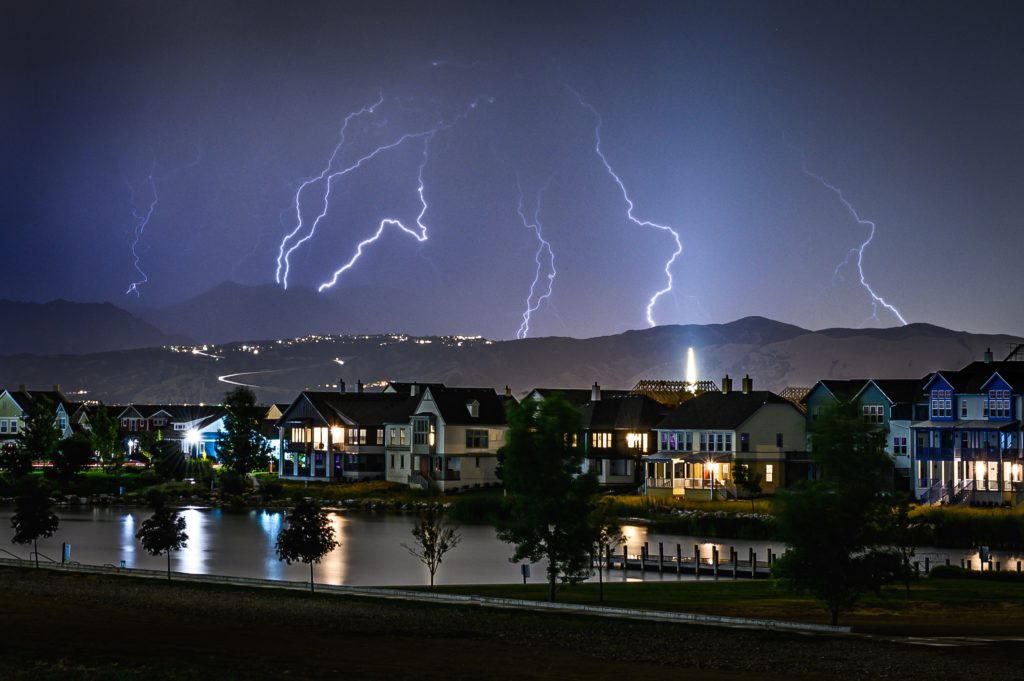
The results of rising temperatures came to life this summer when massive volumes of lightning strikes hit the Bay Area. The incident, now being called the “Lightning Seige of 2020,” resulted in an estimated 12,000 lighting strikes caused nearly 600 ignitions. 

multiple lightning bolts strike the hilltop behind a city

The Impact on Humans and Atmospheric Conditions

Needless to say that wildfires threaten human life regarding the potential loss of life and property. But, the resulting smoke is also a major health hazard. Long-term exposure to the soot particles from the smoke is linked to higher rates of heart and respiratory issues. Even if you don’t live in an area that is often directly affected by wildfires, smoke can travel thousands of miles and impact communities far and wide.

In addition to air pollution, wildfires also threaten the health of our water supplies. The destruction of nature also leads to soil erosion, which increases the chances of dangerous mudslides.

Wildfires also harm our atmospheric conditions by releasing increased amounts of carbon emissions into the air. Carbon stored in trees and the soil gets released into the air when burned. Then, the loss of trees makes it harder to offset our own carbon emissions because of the way trees and other vegetation pull carbon dioxide from the atmosphere and release oxygen.

What is the Solution to Wildfires?

So, what can be done to help prevent wildfires or offset their impact? Indigenous peoples have a solution. As the original stewards of the land, Indigenous people have a wealth of ancestral knowledge about how to best live in harmony with nature. Native Americans are continuing the practice of organized burning, a traditional technique that started as early as a millennia ago. The process involves intentionally burning a section of land in a controlled manner, to clear away excess vegetation and reduce the risk of natural wildfires.

The Yurok, California’s largest Native tribe, works with Cal Fire and the Nature Conservancy to conduct annual burns. Margo Robbins, a member of the Yurok, told the New York Times that her people’s cultural burning practices are very similar to that of the Aboriginal burning strategies used in Australia. Research has shown that the Aboriginal burning program has cut down wildfires by and 50% and reduced carbon emissions by more than 40%.

But, as Dragovich mentioned in the video above, there isn’t just one solution to wildfires. At “Through the Ashes,” Dragovich and Carrol partnered with the Nature Conservancy to promote a program that would plant a billion trees. Planting trees is a direct action we can take to offset the deforestation and carbon emissions caused by wildfires.

What Can You Do to Help?

You can support the work of the Nature Conservancy by making a charitable donation or volunteering at their events. You can also support the Rainforest Alliance, an international non-profit organization that works to protect forests and improve the livelihoods of farmers and communities most affected by forest fires. Finally, you can help one tree at a time by planting a tree in your local community!

Wildfires are a daunting challenge that we face as a collective. But, if all work together to put these solutions into action, we can protect our Planet Home and rise from the ashes.

Filed Under: Eat, Recent Tagged With: land stewardship, wildfires

Why We Need to Prioritize Health and Wellness

August 31, 2020 by Antony Randall Leave a Comment

The year 2020 has been stressful, to say the least. Collectively we have experienced a global pandemic, continued calls for racial justice, wildfires, hurricanes, and power outages – just to name a few of the stressors impacting our everyday lives. This year has taken a toll on each of us in one way or another and has left us processing new challenges to our physical and emotional health and wellness.

Now more than ever, we must prioritize our mental health and wellness. Many believe they don’t have the time or capacity to prioritize mindfulness practices, but this is far from the truth. Self-care doesn’t have to consume a large amount of time. It can be as simple as taking a 10-minute break out of your day to do some breathing exercises. It can be starting every morning with a cup of tea or ending the night with a journaling exercise. It can be whatever works best for you, but we must remember that self-care is essential.

The Origins of Self-Care

We often categorize self-care as shallow or vain, but the reality is that this concept has an incredibly deep and rich history. The term “self-care,” coined in the 1950s, was originally a medical term to encourage patients to spend time caring for themselves. It became popularized outside of the medical community in the 1960s by the Black Panther Party. The Black Panthers were organizers who fought for Black liberation and in this work emphasized the importance of community care. From healing circles to food distribution programs to opening health clinics, their organization focused on ensuring that everyone was fed, well-rested, and emotionally nurtured. Today’s community organizations must learn and adopt these practices in our work in order to ensure success. Every successful movement throughout history has created systems of support for themselves and their communities.

Sustaining The Movement

Whether you’re passionate about environmental justice or any other cause close to your heart, this work can oftentimes feel overwhelming and lead us to burnout. Burnout is the physical, mental, or emotional exhaustion often caused by long term involvement in taxing work. While anyone is susceptible to burnout, activists commonly feel like the weight of the world rests on their shoulders. In a 2015 study, it was observed that roughly half of the activists who reported feeling burnout ended up leaving the movement entirely.

Those working in the field of environmental justice often feel like they are running out of time to address the planet’s biggest challenges, but we need to remember to put our own masks on before assisting others. This is to say that if we are not well cared for, how can we expect to take care of others or the environment? Our individual health and wellness are directly linked to our ability to properly sustain our efforts to improve the planet. A movement is nothing without the people behind it. If we do not care for ourselves, we have a much smaller chance of succeeding at a given task. Even world leaders in the field of environmental action need to take breaks and recharge every now and again.

Environmental Influence on Health and Wellness

Just as our health impacts our ability to do this work, the environment impacts our health and wellness. While there are a variety of factors that influence our mental health from genetics to personal history, one of the most overlooked is the environment. Growing up in an area with unhealthy air quality or polluted water supplies can have a drastic impact on one’s health. For example, in Flint, Michigan, the water crisis, which began in 2014 and continues to exist, resulted in Flint residents developing severe rashes, hair loss, elevated blood lead levels, and a variety of other health issues. Activist Mari Copeny, also known as Little Miss Flint, has been advocating for Flint residents since the very beginning of the water crisis. A Planet Home solutionist, Copeny has used her platform to raise awareness and give back to her community.

Similarly, extreme weather conditions or natural disasters often leave families displaced from their homes which can result in post-traumatic stress disorder. The environment can also impact our health quite positively. For example, access to nature has been correlated with lower cortisol levels, a hormone associated with stress. Spending time in the sunlight has been shown to increase the brain’s release of serotonin, a hormone that helps to regulate anxiety.

Your Wellness Journey

We encourage you to reflect on your own self-care journey and urge you to continue prioritizing your mental and emotional wellbeing. One resource to look into on your wellness journey is the Anxiety and Depression Association of America or ADAA for short. ADAA dedicates their work to the prevention, treatment, and cure of anxiety, depression, OCD, PTSD, and co-occurring disorders through education, practice, and research. Their website includes treatment guides, resources for support, and can connect you with therapists who specialize in treating anxiety and related disorders.

Remember that rest and recovery are key parts of advocating for a better tomorrow. Challenge yourself to commit to strategies that will maintain your energy and motivation.

Filed Under: Recent Tagged With: health and wellness

  • « Go to Previous Page
  • Page 1
  • Interim pages omitted …
  • Page 50
  • Page 51
  • Page 52
  • Page 53
  • Page 54
  • Go to Next Page »

Primary Sidebar

Recent Posts

  • PLANET HOME Announces $1 Million Tough Tech Prize at Inaugural Gala During Tough Tech Week
  • Planet Home and DataEnergy are solving the Green Computing Dilemma with Renewable AI Infrastructure
  • The Great AI Scale-Up: Balancing Compute Power with Planetary Boundaries
  • The Algorithm’s Bargain: Is AI Really for Good?
  • Code, Culture, and Creation: How AI is Remixing Entertainment’s DNA

Recent Comments

  • Liam Jacobs on Fricken’ Flying Taxis: The Future of Travel is Closer Than You Think
  • Izabella Bauer on The Pressing Plastic Problem
  • Broderick Ruiz on The Pressing Plastic Problem
  • Cherish Velez on The Pressing Plastic Problem
  • Anika Scott on The Pressing Plastic Problem

Archives

  • November 2025
  • April 2025
  • February 2025
  • January 2025
  • June 2022
  • April 2022
  • March 2022
  • February 2022
  • January 2022
  • December 2021
  • November 2021
  • October 2021
  • September 2021
  • August 2021
  • July 2021
  • June 2021
  • May 2021
  • April 2021
  • March 2021
  • February 2021
  • January 2021
  • December 2020
  • November 2020
  • October 2020
  • September 2020
  • August 2020
  • July 2020

Categories

  • AI
  • Community
  • Eat
  • energy
  • Featured
  • Live
  • Make
  • Move
  • Network
  • Press
  • Recent
  • Solutionist 100
  • Solutionists Making Moves
  • Solutions

Meta

  • Log in
  • Entries feed
  • Comments feed
  • WordPress.org

Design

With an emphasis on typography, white space, and mobile-optimized design, your website will look absolutely breathtaking.

Learn more about design.

TRENDING NOW

  • PLANET HOME Announces $1 Million Tough Tech Prize at Inaugural Gala During Tough Tech Week
  • Planet Home and DataEnergy are solving the Green Computing Dilemma with Renewable AI Infrastructure
  • The Great AI Scale-Up: Balancing Compute Power with Planetary Boundaries
  • The Algorithm’s Bargain: Is AI Really for Good?
  • Code, Culture, and Creation: How AI is Remixing Entertainment’s DNA

NEVER MISS A SOLUTION!

Sign up for our mailing list to stay up to date on planet saving solutions, news, and events from PLANET HOME!


BROWSE BY TAGS:

action carbon carbon emissions circular economy coronavirus eat education energy environment esg events fashion finance food green holidays industry lifestyle live make material science move music nature ocean oceans ocean stewardship planet plant-based plastic profile recycling s100 solutionist solutionists solutions sustainability tech technology tiktok transportation vegan waste water wildlife
Locations
Resources
Legal

Footer

Locations
Resources
Legal
  • Facebook
  • Instagram
  • LinkedIn
  • Pinterest
  • Twitter
  • YouTube
  • San Francisco
  • Los Angeles
  • New York
  • About PLANET HOME
  • Contact
  • Media
  • Employment
  • Terms of Use
  • Privacy Policy
  • Press

©2021 Planet Home. All rights reserved.
Use of and/or registration on any portion of this site constitutes acceptance of our User Agreement (updated 5/25/18) and Privacy Policy and Cookie Statement (updated 6/8/21) Your California Privacy Rights. The material on this site may not be reproduced, distributed, transmitted, cached or otherwise used except with the prior written permission of PH.

This website uses cookies to improve your experience. We'll assume you're ok with this, but you can opt-out if you wish. Cookie settingsACCEPT
Privacy & Cookies Policy

Privacy Overview

This website uses cookies to improve your experience while you navigate through the website. Out of these cookies, the cookies that are categorized as necessary are stored on your browser as they are essential for the working of basic functionalities of the website. We also use third-party cookies that help us analyze and understand how you use this website. These cookies will be stored in your browser only with your consent. You also have the option to opt-out of these cookies. But opting out of some of these cookies may have an effect on your browsing experience.
Necessary
Always Enabled
Necessary cookies are absolutely essential for the website to function properly. This category only includes cookies that ensures basic functionalities and security features of the website. These cookies do not store any personal information.
Non-necessary
Any cookies that may not be particularly necessary for the website to function and is used specifically to collect user personal data via analytics, ads, other embedded contents are termed as non-necessary cookies. It is mandatory to procure user consent prior to running these cookies on your website.
SAVE & ACCEPT